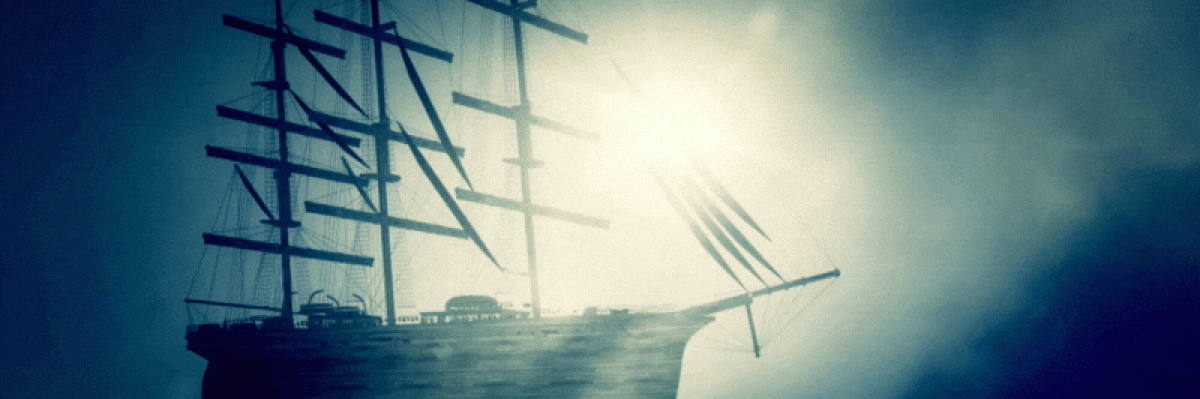
tall ship

Australian Maritime History

tall ship

Tall Ship Lady Julian

The Lady Julian was built on the Thames. She was barque-built with three masts and two decks. The Lady Julian registered to 401 tons. She was 110 feet long with a 40 feet beam. At the bottom deck, in 1788, Deptford carpenters were turning the orlop deck into a prison for 150 women convicts to be conveyed to New South Wales. After New South Wales, the Lady Julian was to go to Canton in China to bring home a cargo of tea. The Lady Julian was commanded by Captain Aitken, and the master and government agent was Lieutenant Thomas Edgar.

In early July 1789 the Lady Julian slipped her moorings at Galleon's Reach in the Thames and made for the Mother Bank, off Portsmouth. On 29 July 1789, the Lady Julian sailed with convicts, cattle pens, poultry boxes. She cleared Rame Head and headed out into the Atlantic and set a course for the northwest corner of Spain, thence due south to the Canary Islands. A couple of weeks out from Plymouth the Lady Julian passed Madeira and veered slightly for Santa Cruz de Tenerife on the northern coast of the island, sheltered from the prevailing winds by a long headland.

From Tenerife, the Lady Julian's route to Sao Tiago, Cabo Verde took them west-south-west 400 miles from the coast of West Africa. They passed the islands of Sao Nicolas and Boa Vista on the starboard beam. They sailed into the harbour of Porto praya on Sao Tiago, their last brief stop in the Northern Hemisphere. After flopping around in the doldrums, the Lady Julian sighted the city of Recife and headed down the coast of Brazil to the port of Sao Sebastian, the harbour of Rio de Janeiro. The harbour at Rio de Janeiro had forts on either side with a bar at the mouth.

In December the Lady Julian heads for the Cape of Good Hope, under the control of the Dutch East India Company. From Rio to the Cape of Good Hope, they had a reasonably fast passage of 50 days. On 31 March 1790, the Lady Julian left Table Bay with the cattle rather uneasy and a gale blowing from the south-east. The weather was hazy. There was nothing between them and Sydney Cove. The southern most point of Van Dieman's Land, Tasman's Head was sighted six weeks out from Cape Town.

In June 1790 the Lady Julian was sighted from South Head and she sailed into Sydney Harbour. It took 5 days to unload her and she was taken across to the north shore to be careened. On 25 July the Lady Julian left Sydney Cove and six days later sailed past Norfolk Island. In October 1790 she reached the Whampoa warehouses on the Pearl River. The Lady Julian arrived back in London early in 1791.

Resources

The Floating Brothel: The Extraordinary True Story of an Eighteenth-Century Ship and its Cargo of Female Convicts - In July 1789, the Lady Julian set sail from England, bound for the penal colony at Sydney Bay, New South Wales, and bearing some 240 women sentenced, mostly for petty crimes, to "transportation to parts beyond the seas." The intention of this voyage was twofold: to relieve overcrowding in British jails and t0 provide sexual comfort and eventually children to the male prisoners, from whom nothing had been heard in more than a year. One year later, the ship arrived, its cargo augmented by a number of infants born along the route to the "wives" of her officers and crew.

Batavia's Graveyard: The True Story of the Mad Heretic Who Led History's Bloodiest Mutiny - In 1629, the Dutch merchantman Batavia grounded on a desolate atoll near Western Australia. Of the 200 survivors, 115 were subsequently murdered, in coldest blood, by a group of the ship's sailors and their psychopathic leader, Jeronimus Corneliszoon. Batavia's Graveyard is an unnerving, measured account of the incident.

.

Home

Australia Index

James Craig

The Duyfken

Sloop Norfolk

Baudin & Flinders

Newcastle Maritime

Lady Julian

HMS Guardian

Aubrey/Maturin Books