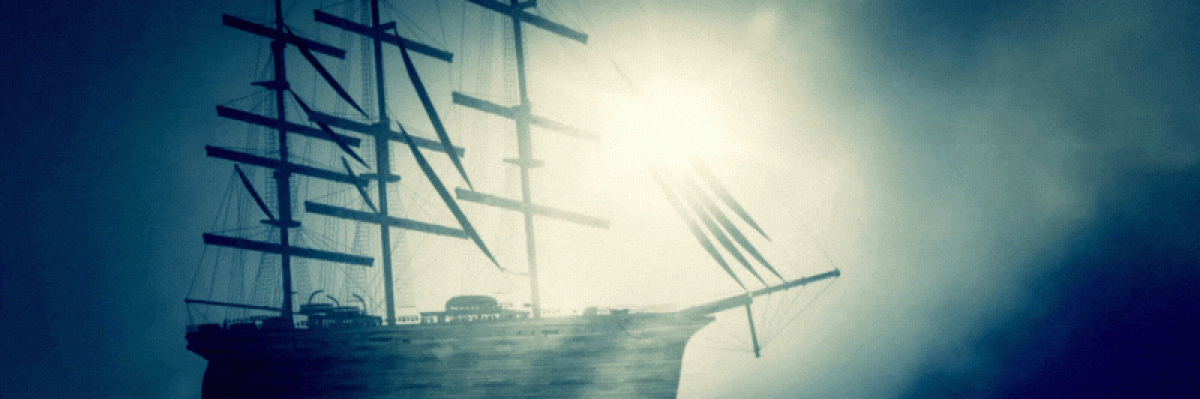
portuguese sailing ship

Australian Maritime History

sailing  ship

The Porguguese Discovered Australia

What? The Portuguese discovered Australia! That is not what I was taught. I was taught at school that Captain Cook discovered Australia. The latest historical texts propound that Janszoon in the Duyfken was the first European to set foot on Australia. What if this was not true, and what if there was evidence that other Europeans visited and explored Australia years before the Dutch and Captain Cook. Many have proposed that the Portuguese explored and charted the coast of Australia ninety years before the recorded visits by the Dutch mariners.

The main evidence for saying that the Portuguese discovered Australia is a set of Portuguese maps known as the Dieppe maps. The Dauphin map of 1536 does resemble the real shape of Australia. But after adjusting the projection of the map, allowing for magnetic variation, and allowing for the erration error, then it is possible to redraw the Dauphin map so that it looks very close to the outline of the Australian Coast. When the Dauphin map is redrawn using mercator projection, then it is unmistakably the real shape of Australia.

During the first half of the nineteenth Century, these Dieppe maps were known in England and France. They were accepted by the great geographers of the time as evidence that the Portuguese had discovered Australia. Here is a list of those who accepted this thesis: Alexander Dalrymple, Matthew Flinders, Joseph Banks, Major Rennel, John Pinkerton , and James Burney.

But , from 1850, this acceptance of the Portuguese Discovery of Australia was attacked and suppressed by historians and the Admiralty. The reasons for this were political and religious. Political because Portugal became a competitor in the race towards colonialism and religious because Portugal was a Catholic country and England was Protestant. In 1895 George Collingridge was attacked by the critics for this view in his book, The Discovery of Australia.

The main pieces of evidence are the Dieppe maps, and circumstantial evidence such as the Mahogany Ship that was sighted and subsequently lost in the Warnambool region. Another intriguing find is the ruins of a fort at Bittangabee Bay in New South Wales that consisted of walls made of local stone with seashell mortar. Also, Portuguese cannons were found on Carronade Island in Western Australia. Unfortunately the Portuguese kept most of their charts and logs secret and took them off captains when they returned and placed them in secure archives in the Casa do India. Unfortunately, Lisbon had an earthquake in the eighteenth Century and all these records were lost. So, there is no concrete proof that the Portuguese did in fact discover Australia, but the circumstantial evidence points strongly in that direction. Let us hope that someone digs up some archive that gives a definitive answer, because the truth is always better than a bunch of half lies and political exediency.

Resources

.

.

Home

Australia Index

Quiros

Luiz Torres

Dirk Hartog

Abel Tasman

William Dampier

The Duyfken

James Craig

Mary Bryant

Sloop Norfolk

Baudin & Flinders

Newcastle Maritime

Maritime Museum

First Fleet

Second Fleet

Lady Juliana

HMS Guardian

Sir Robert Seppings

Tasmanian Coasters

Chicora

Red Jacket

The Endeavour

Brig Frederick

The Sarah

Aubrey/Maturin Books